Chapter 3 Primes
Definition 3.0.1.
A natural number \(k\) is a proper divisor of an integer \(n\gt 1\) provided \(k\vert n\) and \(1\lt k\lt n.\)
Definition 3.0.2.
A prime is a natural number \(p\gt 1\) which has no proper divisors.
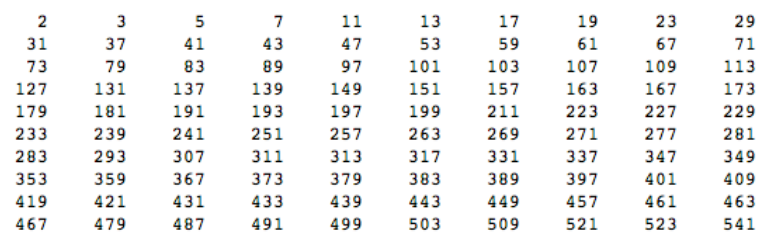
Notice that there are many pairs of primes \((p,p+2),\) like
We call these primes twin primes, and note one of the most famous open conjectures in number theory.
Conjecture 3.0.4 (Twin Prime Conjecture).
There are infinitely many primes \(p\) such that \(p+2\) is also prime.
This conjecture was first proposed by Euclid sometime around 300 B.C.
Two other very famous conjectures in number theory concern the sum of two primes. In a letter to Euler in 1742, Christian Goldbach suggested the following conjectures.
Conjecture 3.0.5 (Binary Goldbach Conjecture).
Every even positive integer is either prime, or the sum of two primes.
Conjecture 3.0.6 (Ternary Goldbach Conjecture).
Every odd positive integer is either prime, or the sum of three primes.
In 1937, I.M. Vinogradov produced a proof of the Ternary Goldbach Conjecture for large integers 1 . Thus the question is settled for integers \(N,\)
Unfortunately, this number is not quite small enough for computers to tackle the "small" integers that are left to check. But in 2013, Harald Helfgott proved that the result is true for \(N \gt 10^{27},\) a small enough bound so that the remaining cases could be checked. Thus Conjecture 3.0.6 is now a theorem due to Helfgott.
The most famous proven result in prime number theory is called the Prime Number Theorem. To state this we fist need some notation and a definition.
Convention 3.0.7.
Let \(f(x)\) and \(g(x)\) be two real valued positive functions. We write \(f(x) = O(g(x))\) and say "\(f(x)\) is big-oh of \(g(x)\)" provided there is a real number \(c_1 \gt 0\) such that for \(x\) large enough
We write \(f(x) = o(g(x))\) and say "\(f(x)\) is little-oh of \(g(x)\)" provided that
We say that \(f\) and \(g\) are asymptotic, written
provided
Finally we say that \(f\) is of order \(g,\) written
provided there exist real numbers \(c_1,c_2\gt 0\) such that for \(x\) large enough we have
Definition 3.0.8.
Let \(x\geq 0\) be a real number. Denote by \(\pi(x)\) the number of primes less than \(x;\) we call \(\pi(x)\) the prime counting function.
Theorem 3.0.9 (Prime Number Theorem).
For \(\pi(x)\) the prime counting function, we have
where \(\log(x)\) denotes the natural logarithm of \(x.\)
This theorem was conjectured by Legendre and Gauss in the 1790's, but was not proven until well after that in 1896. In that year, the Prime Number Theorem was proven independently by both Hadamard and de la Vallée Poussin.