Section 1.2 The Diophantine equation \(a^2+b^2=c^2\)
In calculus classes the world over we use blindly that in a right triangle, that the square of the hypotenuse is equal to the sums of the square of the other two sides. Indeed by just looking at the first few integer solutions 1 to
we can see a pattern.
If we consider \(n=\frac{p}{q}\) to be a rational number and clear denominators we get the general solution
There is a wonderful proof of Pythagoras' theorem which we will consider now.
Theorem 1.2.1 (Pythagorean Theorem).
In a right triangle, the square of the hypotenuse is equal to the sums of the square of the other two sides.
Proof.
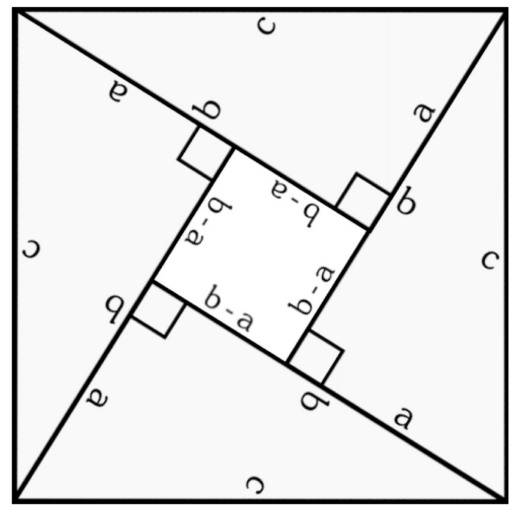
Without loss of generality, consider Figure 1.2.2 below. The area of the outside square is \(c^2.\) This is equal to the area of the inside square plus that of the four triangles inside the large square. Thus
which is the desired result, proving Pythagoras' theorem.
After considering the diophantine equation \(a^2+b^2=c^2,\) it is almost immediate to inquire about solutions to \(a^3+b^3=c^3,\) \(a^4+b^4=c^4,\) or in general \(a^k+b^k=c^k\) for \(k\gt 2.\) Unfortunately this is a very hard thing to consider. The question was posed by Pierre de Fermat in 1637, and remained unproven until 357 years later in 1995, Andrew Wiles succeeded in proving it. Wiles proved the following theorem.
Theorem 1.2.3.
For \(k\in\mathbb{N}\) with \(k\gt 2,\) the equation \(x^k+y^k=z^k\) has no solutions for \(x,y,z\in\mathbb{N}.\)
This proof takes up around 200 pages, and so we will not reproduce it.